
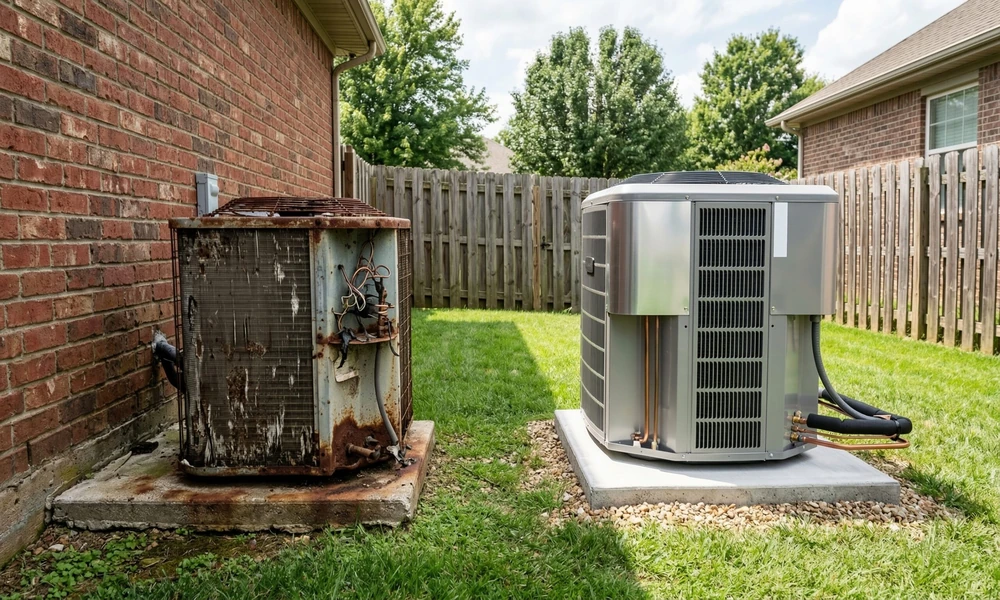
Fourteen years. That is the number I keep landing on when a Lynchburg homeowner asks me how much life is left in their unit, and it is almost never the number they wanted to hear.
The honest answer is that equipment lifespan in central Virginia is a range, not a rule. A heat pump that runs year-round in Amherst County can wear out years before the same model sitting in a basement in Minnesota, because here the machine heats in January and cools in July without much of a break in between. Add our muggy summers and the red clay that swallows outdoor condensers, and you get a service life that depends far more on how the system was installed and maintained than on the logo on the front panel.
What follows is the version of this answer I would give a neighbor: what the numbers really mean, which parts die first, and the handful of decisions that move the needle the most.
What the life expectancy numbers actually measure
Most published ranges describe the midpoint of a bell curve across thousands of installations. Your house is one data point on that curve, and it can sit at either end.
Here is the rough spread for the equipment we see most in this region:
| System type | Typical service life | What usually ends it |
|---|---|---|
| Air source heat pump | 12 to 15 years | Compressor wear from year-round runtime |
| Gas furnace | 15 to 20 years | Heat exchanger cracks, ignition and control board failures |
| Central air conditioner | 12 to 17 years | Refrigerant leaks, outdoor coil corrosion |
| Ductless mini split | 12 to 20 years | Drain clogs and blower motor failure |
Notice what the table does not say. It does not say a 13-year-old heat pump is finished. Age is context, not a verdict. I have watched 22-year-old furnaces chug along in well-sealed crawlspaces, and I have watched 8-year-old systems get torn out because a previous installer oversized the equipment and the compressor spent its whole short life short-cycling.
The federal government’s own consumer guidance puts a typical central system in the 15-year range, then recommends a professional evaluation once you pass the decade mark. That is a reasonable fence to stand at.
Why Virginia equipment ages faster than the sticker suggests
Three local conditions do quiet damage, and none of them show up on a spec sheet.
Runtime. A heat pump in our climate heats and cools. Two full seasons of work per year is roughly twice the duty cycle of a cooling-only unit in a northern state. Compressors have a finite number of hours in them, and we spend them faster.
Humidity. High dew points mean your system pulls gallons of water out of the air every day in July. That water has to leave through a condensate drain, and when that line clogs with algae, the pan overflows, the cabinet rusts, and occasionally a ceiling pays the price.
Our soil and landscape. Outdoor units sit next to flower beds, under decks, and in the shade of crepe myrtles that drop leaves straight into the coil fins. A condenser buried in mulch with a dirty coil runs hotter and dies younger. This is the single most preventable cause of early failure I see, and it costs you nothing but a rake.
If you want to go deeper on the efficiency side of this, the Department of Energy publishes plain-language explainers on how heat pumps behave in mixed climates, and it is worth twenty minutes before you sign anything.
Which parts fail first, and what that tells you
An HVAC system does not die all at once. It dies in stages, and reading those stages is how you decide whether to repair or replace.
Year one to five, you should see almost nothing. A capacitor here, a thermostat there. If you are paying for major components in the first five years, the problem is usually installation quality, not bad luck.
Years six to twelve bring the wear items. Blower motors, igniters, inductions assemblies, contactors, and increasingly, the control boards that make modern equipment talk to a smart thermostat. These repairs are normal and worth doing. They are the cost of ownership, not a death sentence.
The decision point shows up when the big three fail: the compressor, the heat exchanger, or the evaporator coil. Those are the parts that cost enough that a repair starts competing with a replacement. My rule of thumb is simple. Multiply the age of the system by the cost of the repair. If that number clears five thousand, you are usually better off putting the money toward new equipment, because a 12-year-old system with a new compressor is still a 12-year-old system with a 12-year-old everything else.
A maintenance routine you can actually keep
You do not need a clipboard and a torque wrench. You need four habits, and two of them take under ten minutes.
- Change the filter on a schedule tied to your house, not the calendar. Pets, pollen season, and how often you run the blower all change the interval. A suburban home with two dogs in Bedford County can load a filter in four weeks.
- Hose off the outdoor coil every spring. Kill the power at the disconnect first, then rinse from the inside out. Do not use a pressure washer on the fins.
- Pour a cup of distilled vinegar down the condensate drain in late spring. It is unglamorous and it prevents a whole category of service calls.
- Book a professional tune-up once a year, and put it on the fall calendar. The trade association ACCA has long made the case that annual service pays for itself in efficiency and avoided breakdowns, and in my experience that holds up.
When the day comes that you do need a hand, ask around rather than clicking the first ad that shows up. Neighbors know who shows up on time, and local reputations in this trade are earned slowly. Companies like Wooldridge provide Residential HVAC services in Lynchburg, VA, and that kind of established local presence is what you want standing in your mechanical closet.
The refrigerant question hanging over all of this
If your system was built before the middle of the last decade, it likely uses R-410A, which is itself being phased down in favor of lower-global-warming alternatives. The Environmental Protection Agency manages that transition, and the practical effect on you is straightforward: refrigerant for older equipment gets more expensive every year.
That does not mean you should rush out and replace a working system. It does mean that a refrigerant leak on an older unit is a much more serious diagnosis than it was ten years ago, because the repair now carries a rising materials cost on top of the labor.
Here is my stance. If your system is past 12 years old and it needs a sealed-system repair, replace it. If it is under 10 and the fix is a motor or a capacitor, fix it and keep the other thousand dollars in your pocket. And if you are somewhere in between, get the compressor checked before you decide, because that is the part that determines which side of the line you are on.
What is your system doing right now that made you look this up? Start there, and ask a tech you trust to tell you the age, the refrigerant type, and the condition of the coil before anyone quotes you a number.